
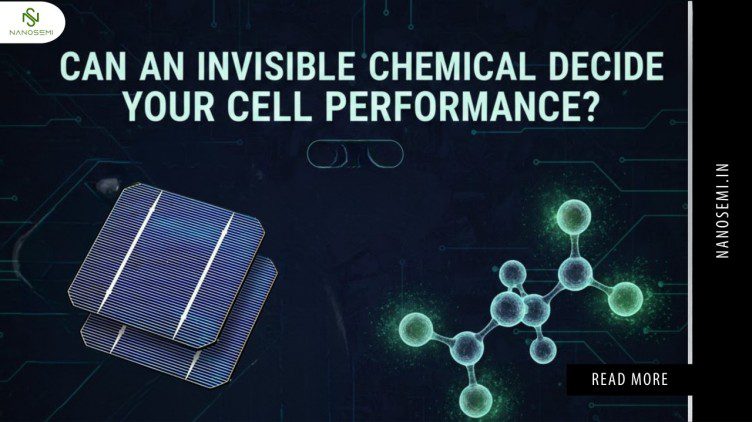
In solar and semiconductor manufacturing, few chemicals are as essential—and as underestimated—as Hydrofluoric Acid (HF).
It is colorless, invisible, and used in extremely controlled quantities. Yet even a slight deviation in HF chemistry can determine whether a cell meets efficiency targets or quietly underperforms.
Why HF Matters Today
HF plays a central role in:
- Oxide removal
- Surface cleaning
- Texturing and etching processes
As cell architectures become more advanced and wafers thinner, HF process windows are shrinking. What once worked reliably now requires near-perfect consistency.
Purity of hydrofluoric acid (HF) critically impacts solar cell efficiency and manufacturing yield, primarily because trace metallic impurities create defects in the silicon lattice that reduce performance. The solar cell industry requires ultra-high purity (UHP) HF, with impurities at parts-per-billion (ppb) levels, to minimize these negative effects.
How HF Influences Cell Performance
HF impacts the cell at the surface level, where performance is defined.
- Incomplete oxide removal leads to poor surface passivation and voltage loss
- Excessive etching increases surface damage and recombination
- Trace metal contamination in HF introduces electrical defects
- Aging or unstable HF baths create non-uniform results across wafers
These effects are invisible to the eye but show up clearly in Voc, FF, and long-term reliability.
Why HF-Related Issues Are Hard to Detect
HF-induced performance loss often:
- Does not create visible defects
- Passes initial inspection
- Appears statistically across batches
- Manifests after thermal steps or field exposure
Without correlating electrical data to HF chemistry health, the root cause is often missed.
Common Misconceptions About HF
- “HF concentration alone defines performance.”
- “If etch rate is stable, HF is fine.”
- “Rinse quality matters more than HF itself.”
In reality, impurities, bath age, temperature, consistency and delivery stability matter just as much.
The Real Takeaway
HF may be invisible, but its impact is not.
In modern cell manufacturing, HF consistency and purity defines surface quality, and surface quality defines performance that ultimately defines efficiency and yield optimization.
The smallest variation in HF chemistry can quietly set the ceiling for efficiency, yield, and reliability.
Questions for Reflection:
- How closely do you monitor HF health beyond concentration and etch rate?
- Could HF variability be the invisible limit on your cell performance?
- Is your HF having enough consistency and purity?
Connect us to know more and industry best quality HF supply
Nanosemi Tech Solution Pvt. Ltd
sales@nanosemi.in
Also Read : Industry Misconception: Reflectivity Measurement of Polished Silicon Surfaces Using D8-Spectroscopy Reflectometer